
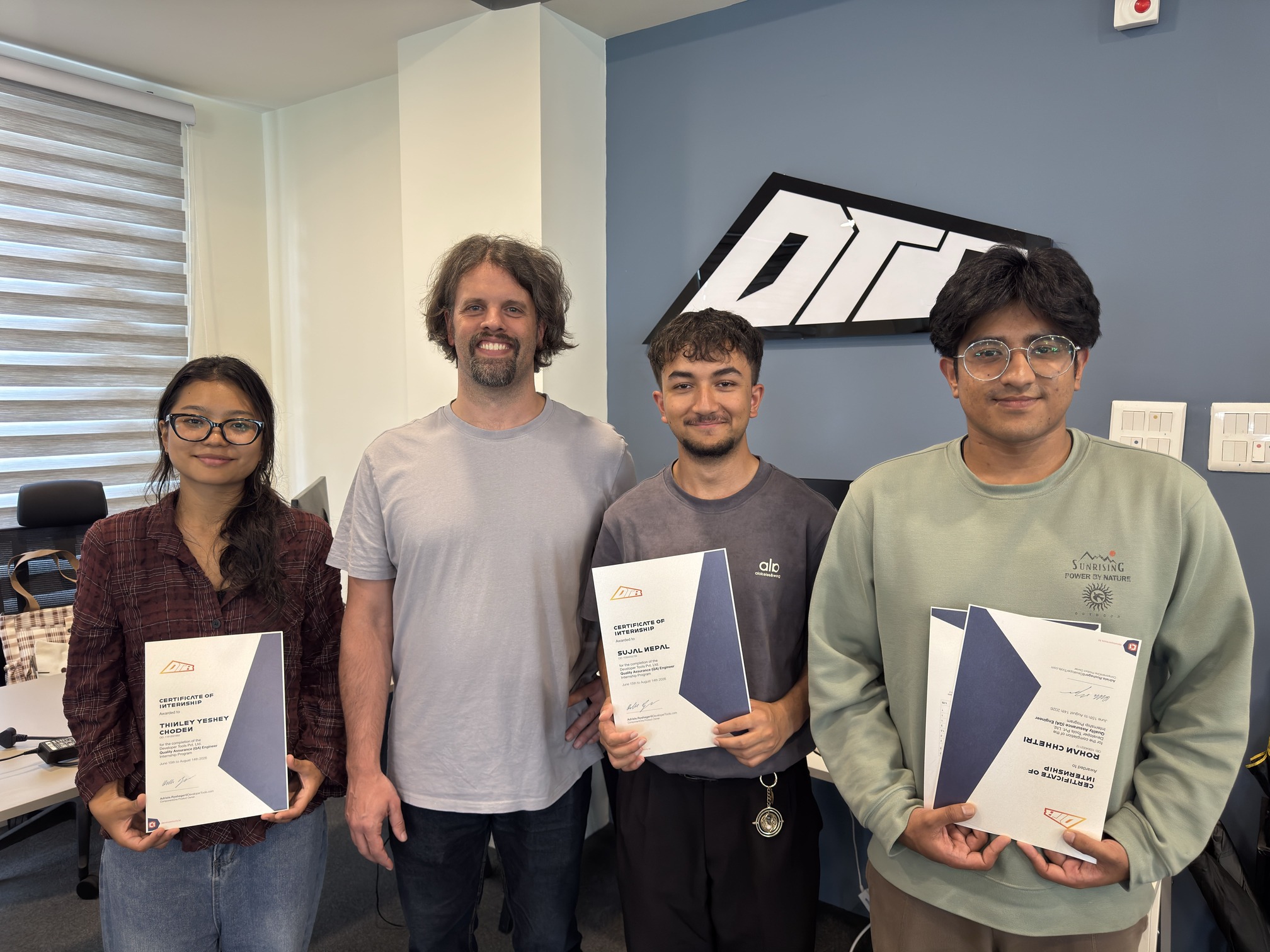
At DTB, Quality Assurance interns learn by contributing to the same product workflows and in the same dynamic environment as the wider team. Rohan, Sujal, and Thinley took part in installer testing, issue verification, documentation, and technical sessions alongside experienced colleagues.
Their experience reflects what the DTB internship is designed to provide: meaningful responsibility, structured guidance, and direct exposure to the professional standards required to support ComponentOne, a .NET component and control suite used by developers worldwide.
Joining the Team Through Real Work
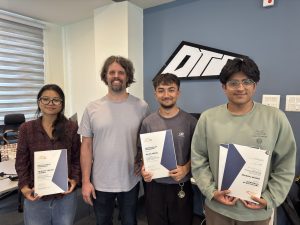
Interns Thinley, Sujal, and Rohan with PO Adriele on their last day of internship
The three interns joined DTB through different educational and professional paths. They expected the early stages of the internship to focus largely on observing workflows while they learned the foundations of software quality assurance. Instead, they began participating in actual QA assignments during onboarding.
Their tasks were matched to their level of experience and reviewed by experienced team members. At the same time, their findings and documentation needed to be clear and reliable because other team members would use that information in their work.
As the interns became familiar with DTB’s tools and processes, they received assignments requiring greater independence. This progression allowed them to contribute as members of the team while continuing to receive appropriate guidance and review.
The experience also changed their understanding of C1. Before joining DTB, they had viewed it as a single product. They soon discovered the range of products and controls within the suite and the coordinated work required across all C1 teams.
Learning the Discipline of Production QA
The interns’ first assignments focused primarily on testing ComponentOne installers. They verified installations, checked file and folder structures, and confirmed that packages contained the expected resources.
Production QA demanded more than identifying a possible defect. Each issue had to be reproduced consistently and documented clearly, with the expected and actual behavior distinguished. After a fix was implemented, QA verified that it resolved the original problem without introducing another issue.
Problems that initially appeared inconsistent often required repeated testing. The interns learned to change or remove one variable at a time until they could identify the conditions causing the problem.
During one assignment, Rohan noticed that sample data was not being populated correctly in a project under test. After reproducing the behavior several times, he reported it to the development team, which confirmed it as a valid bug. He then documented the issue in the company’s issue-tracking platform with detailed reproduction steps, clarified the findings with the responsible developer, and later verified the fix.
The assignment gave him experience with the full issue cycle: investigation, documentation, communication, and verification. This cycle is structured, but the work is not mechanical. Each issue requires judgment: examining behavior from different angles, isolating variables, questioning assumptions, and presenting enough evidence for the next person to act. In practice, QA combines the curiosity of an investigator, the discipline of a researcher, and the clarity of a technical communicator.
Growing Through Guidance and Review
Regular training sessions with QA lead
Not every production scenario can be anticipated or taught in advance. At times, the interns had to step into unfamiliar assignments and learn through investigation. This called for initiative and persistence, supported by teammates and mentors who offered technical guidance, encouragement, and constructive feedback on their work and progress.
The interns were encouraged to ask questions and raise blockers early. As they became more familiar with DTB’s workflows, they handled testing, verification, and documentation assignments with increasing independence.
Collaborating Across Teams and Locations
Collaboration with QA colleagues from our partner company in Myanmar
C1 development involves teams working from different locations. The DTB QA team regularly collaborates with QA colleagues in Myanmar to share technical knowledge and align testing practices.
The interns joined sessions on XAML API testing and UI automation, including build acceptance testing, licensing verification, and the use of focused sample projects to test individual controls.
Beyond the technical topics, these sessions gave the interns direct experience communicating with remote engineers and working with shared terminology, processes, and quality expectations. They also saw how work completed in Bhutan contributes to a broader product workflow.
Building Professional Capability from Bhutan
Through the internship, Rohan, Sujal, and Thinley built capability in production testing, issue verification, documentation, and cross-team collaboration. The value of the experience lay in its combination of inclusion and development: they were trusted with meaningful assignments, expected to meet production standards, and supported as their responsibilities increased.
For students and early-career professionals, their experience offers a clear picture of working at DTB: an opportunity to contribute to a software product used worldwide while developing professional capability through real product work.